

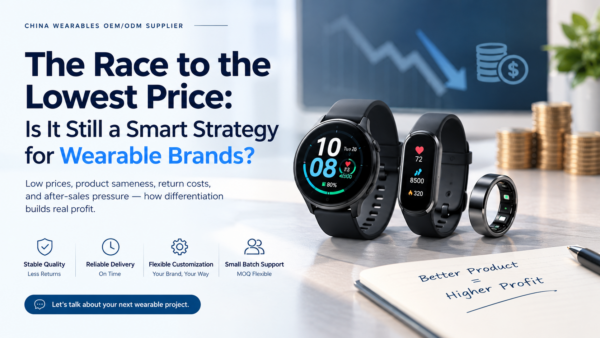
In the smart wearable market, competing on price seems like the fastest way to win customers. But when multiple suppliers offer similar-looking smartwatches and fitness bands, the lowest quotation doesn’t always lead to the highest profit.
From our experience working with wearable products and overseas buyers, the real challenge is not simply reducing the purchase price. It’s building a product business that remains profitable after the sale.
1. Product Homogeneity Makes Price Competition Inevitable
When brands sell similar designs with comparable specifications, buyers naturally compare prices. This creates pressure on margins and makes it difficult to build brand loyalty.
One practical solution is to differentiate through design, user experience, target audience, or product positioning—not just hardware specifications.
For example, a distributor could offer a lightweight fitness band for everyday wellness users rather than competing directly with dozens of generic smartwatches.
2. The Hidden Cost of Low-Priced Wearables
A lower unit price can be attractive, but the total cost of ownership matters more.
Consider a hypothetical example: Brand A saves $2 per unit on a 1,000-piece order, gaining $2,000 in upfront savings. However, if inconsistent quality leads to 30 additional returns, each costing $25 in replacement, shipping, and handling, that saving disappears.
This is an illustrative example, not actual customer data.
Quality consistency, reliable firmware, clear specifications, and responsive after-sales support all influence the final margin.
3. Differentiation Protects Profitability
Differentiation doesn’t always require developing a completely new product.
For many small and medium-sized brands, a mature product with customized logos, packaging, watch faces, or selected features can create a more distinctive market offer without the cost and risk of developing hardware from scratch.
The key is to choose customization that matters to the target customer—and that the business can support reliably.
4. Choose a Manufacturing Partner, Not Just a Price
A capable OEM/ODM partner should help buyers balance cost, quality, lead time, and flexibility.
For emerging brands, small-batch trials and flexible MOQs can reduce inventory risk before scaling. Fast sample preparation—sometimes within seven days, depending on the model and customization—can also help validate a product concept earlier.
The goal is not to pay more unnecessarily. It’s to understand what each price includes and what risks come with it.
Final Thought
In wearables, the cheapest product may win the first order. But a well-positioned product with consistent quality and manageable after-sales costs has a better chance of winning repeat business.
Are you evaluating a new wearable product or reconsidering your current sourcing strategy? Feel free to message me to exchange ideas about product selection, customization, and small-batch trials.
#SmartWearables #OEM #ODM #ProductDifferentiation #B2BManufacturing