

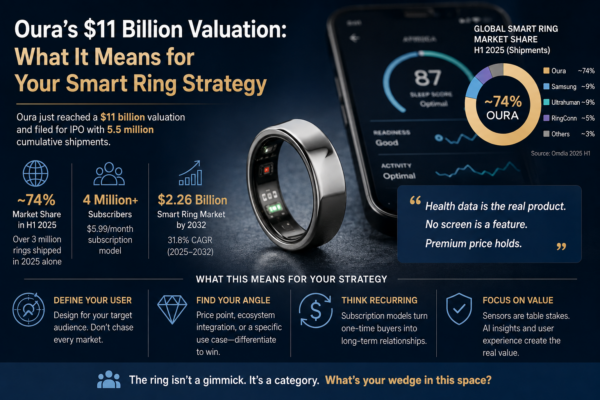
Oura just hit 110 billion USD valuation and filed for IPO with 5.5 million cumulative shipments. With ~74% market share in H1 2025—shipping over 3 million rings in 2025 alone—they’ve proven the ring isn’t a gimmick. It’s a category.
But here’s what importers should actually read into this:
1. Health data is the real product, not hardware. Oura’s subscription model (at $5.99/month) now serves 4 million subscribers, converting single sales into recurring revenue. The sensor stack is mature—the real value is the AI interpreting that data.
2. “No screen” is a feature, not a flaw. Oura didn’t compete on features. They competed on frictionless wearability—3.3g rings, no screen, no notifications. Just data that appears when you check the app.
3. The premium price holds. $349–$499 price points prove consumers pay for genuine value, not just specs.
What does this mean for your strategy?
-
Don’t copy Oura’s product; copy their philosophy. Define who your user is and design for them. If you’re targeting mass market, don’t chase the premium health subscription play—that’s Oura’s turf.
-
Differentiation matters. Samsung (9% share), Ultrahuman (9%), and RingConn (5%) are fighting for the rest. Find your angle—price point, ecosystem integration, or a specific use case (like RingConn’s sleep apnea focus).
-
Think recurring value. Hardware margins compress. Subscription models convert users into long-term relationships.
The ring market is expected to hit $2.26 billion by 2032, growing at 31.8% CAGR. But you need a strategy beyond “we make rings.”
What’s your wedge in this space? Let’s talk.
#SmartRing #WearableTech #Oura #ProductStrategy #ChinaSupplier #HealthTech #OEM #ODM #MarketInsights