

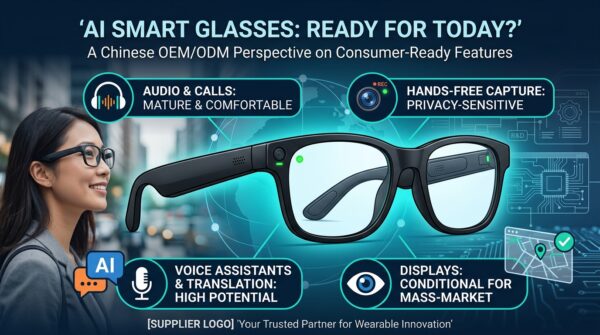
As a China-based smart-wearable OEM/ODM supplier, I see more brands asking the same question: which AI glasses features can actually sell today—not just demo well?
The answer is not “put everything into one pair of glasses.” It is choosing the right feature mix for a clear user scenario.
Audio and calls: ready now
Open-ear audio, calls, music, and voice commands are the most mature use cases. They work without a display, keep the design light, and preserve situational awareness.
For commuter, outdoor, and fitness audiences, this is often the safest first product.
Camera capture: strong, but privacy-sensitive
Hands-free photo and video capture is popular among creators, travelers, and parents. But camera glasses need a visible recording indicator, clear app permissions, secure storage, and local privacy compliance.
A camera should solve a real moment-capture need—not become the main reason consumers hesitate.
Voice AI and translation: high potential
Voice assistants, reminders, object questions, and real-time translation are improving quickly. Translation is especially compelling for travel, retail, and cross-border communication.
However, brands should define whether translation is audio-based, text-scan based, or display-assisted. Each has different cost, latency, battery, and UX requirements.
Displays: powerful, not yet universal
Displays enable navigation, captions, notifications, and translation text. But they increase power consumption, weight, cost, and optical complexity.
For mass-market products, I recommend starting with audio-first or camera-plus-audio models. Add a display only when the target user truly needs visual information.
A practical example
For a European DTC brand, we might position a lightweight audio + camera model for travel creators: 1080p photo/video, open-ear audio, voice assistant, LED capture indicator, and 6–8 hours of mixed use. A display version would be a separate premium SKU, not a forced upgrade.
The winning products will not be the most feature-heavy. They will be the most scenario-clear, privacy-responsible, and battery-realistic.
If you are planning an AI smart-glasses project, feel free to message me to discuss your target market, feature priority, and OEM/ODM requirements.
#AISmartGlasses #SmartGlasses #WearableTechnology #OEMODM #ProductDevelopment