

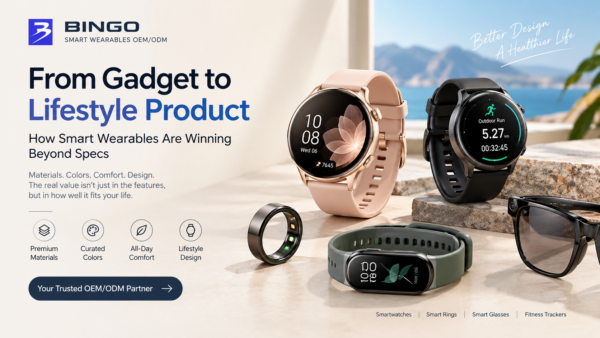
The global smart wearable market has hit a structural bottleneck. While sensors, algorithms, and battery life continue to incrementalize, hardware specifications no longer drive consumer conversion the way they used to.
Today’s buyers don’t just evaluate a smartwatch or smart ring on display resolution or sensor accuracy—they ask: “Does this fit my personal style, and can I comfortably wear it 24/7?”
As an OEM/ODM manufacturing partner behind emerging and established global hardware brands, we have watched this shift unfold firsthand on the factory floor.
Here is how hardware brands are moving away from spec-driven price wars by embracing lifestyle-centric design—and how supply chain customization makes it scalable.
1. Tactile Luxury: Premium Finishes Over Pure Plastic
For years, mass-market wearables relied heavily on standard polycarbonate (PC) and matte black TPU straps. Today, perceived value is defined at first touch.
By replacing basic plastic housings with aerospace-grade aluminum alloys, surgical stainless steel (316L), or ceramic bezels, brands instantly unlock premium positioning.
-
OEM Customization Insight: Micro-sandblasting and physical vapor deposition (PVD) coating allow us to apply high-durability metallic textures—such as Champagne Gold, Gunmetal Gray, or Brushed Rose—without adding excessive unit costs or compromising antenna signal efficiency.
2. Curated Palette Strategy: Seasonal Colorways as Growth Levers
Black and silicone grey are safe, but they rarely inspire emotional purchases or seasonal gifting. Lifestyle wearables treat color as an active brand asset.
-
Data Insight (Example): In a recent production pilot for a European private-label client, introducing a curated Pantone Earth-Tone Series (Eucalyptus Green, Warm Sand, and Terracotta Silicone) increased high-margin direct-to-consumer (DTC) conversions by 32% compared to the standard monochrome SKU.
By leveraging quick-swap strap mechanisms and low-MOQ custom tooling for color matching, brands can refresh product collections seasonally without re-engineering internal PCB layouts.
3. Ergonomics & Biocompatibility: Enabling True 24/7 Wearability
Sleep tracking, continuous heart rate monitoring, and stress metrics require uninterrupted skin contact. If a device causes skin irritation, pressure marks, or wrist fatigue after eight hours, the software experience becomes irrelevant.
-
Skin-Friendly Materials: Transitioning to liquid silicone rubber (LSR), woven nylon, or bio-based vegan leathers dramatically improves breathable comfort.
-
Refined Contours: Reducing case thickness by even 1.2mm through high-density internal component stacking transforms a bulky tech gadget into an ultra-light everyday accessory.
4. Hardware-Software Aesthetics: Cohesive UI & Casing Integration
A lifestyle wearable requires visual harmony between the physical housing and the digital interface.
A polished rose-gold housing running a neon-green industrial UI creates immediate visual friction. Through micro-customization, we support brands with pre-loaded bespoke watch faces, boot animations, and app themes that seamlessly reflect the exterior casing’s aesthetic language.
Rethinking Your Next Product Line
Competing on specs alone leads straight to margin erosion. By elevating materials, color stories, and ergonomic refinement, brands build emotional connection and long-term customer loyalty.
Looking to customize your next private-label smartwatch, smart ring, or screenless tracker?
Let’s connect on LinkedIn or message us directly to discuss how our OEM/ODM platforms can turn your brand’s lifestyle vision into production-ready hardware.
#SmartWearables #OEMODM #HardwareDesign #ProductStrategy #ConsumerElectronics #SupplyChain