

After years of sitting across the table from buyers in Dubai, São Paulo, and Riyadh, I’ve learned that spec sheets don’t sell watches — priorities do. Every season, clients ask us the same question: “Which feature should we lead with?”
Here’s what I’ve actually seen move volume.
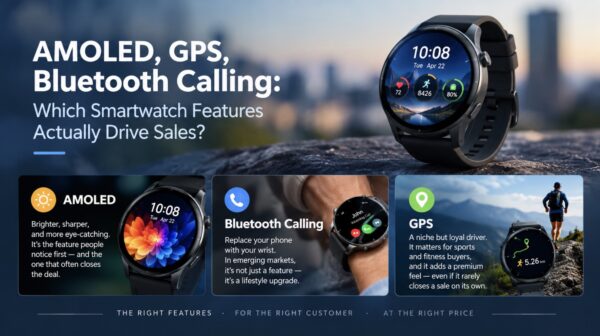
AMOLED displays remain the single biggest conversion driver. The moment a customer sees an always-on AMOLED screen next to a standard LCD, the decision is basically made. It’s the feature people notice in three seconds, before they even ask about specs.
Bluetooth calling, has overtaken GPS as the second-biggest driver in most emerging markets we serve. Buyers in Southeast Asia and Latin America want a watch that can replace glancing at their phone entirely — answering calls on the wrist feels like magic to a first-time smartwatch buyer, and it’s a strong upsell point.
GPS, meanwhile, is a niche-but-loyal driver. It matters enormously to sports and fitness-focused buyers, but for general consumer lines, most end users barely activate it. We still include it because it signals “premium” — but it rarely closes a sale on its own.
The lesson for us as a manufacturer: don’t build watches around what’s technically impressive. Build around what a customer notices in a showroom, feels in daily use, and can explain to a friend. AMOLED wins the glance test. Bluetooth calling wins the lifestyle test. GPS wins the credibility test.
What’s your experience — which feature actually closes deals in your market?
#Smartwatch #Wearables #OEM #Manufacturing #ConsumerElectronics