

How Many Smartwatch Models Should a Distributor Start With? (3–5, With a Framework)
The most common question new smartwatch distributors ask is also the one most suppliers answer with a vague “it depends.” The short answer is 3 to 5 models — but the number itself is less important than the logic behind it. Too few and you cannot test price points or use cases; too many and you buy inventory risk you cannot recover from.
This guide breaks down why 3–5 works as a starting portfolio, what each slot should do, and how to avoid the most expensive mistake distributors make: treating every color and strap variant as a separate model before the hero SKU has proven itself. If you are sourcing a low MOQ private label smartwatch line, this framework applies whether you are ordering 100 units or 500.
Why 3–5 Models, Not 10 — and Not 1
A distributor catalog loses sales for one reason more than any other: too many similar SKUs with unclear differences. If a sales rep cannot explain the difference between two models in one sentence, the buyer defaults to the cheapest option or walks away. Ten similar-looking watches do not give buyers more choice — they give them decision fatigue.
At the other end, one or two models leaves no room to test price sensitivity, channel fit, or consumer preference. You end up forcing a single positioning onto every buyer, and if that model underperforms, you have no data on whether the problem was the product or the price.
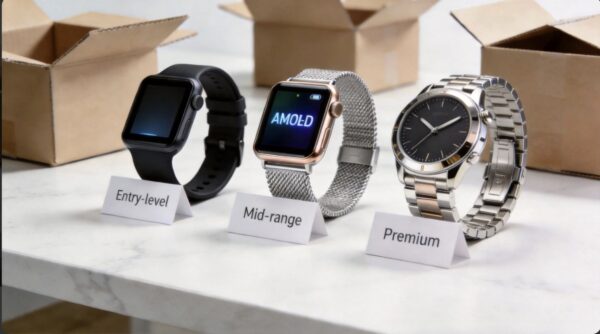
The practical sweet spot is a three-tier core portfolio, with room for one or two style variants on the hero model. That gives you enough spread to learn without turning your first order into a warehouse problem.
>
Not sure how to map your first 3–5 models to real MOQs?
>
Tell us your target market and quantity, and we’ll confirm which models can be branded at that level — without pushing you into inventory you don’t need yet.
> Request Sample Cost & MOQ →
>
The Three-Tier Framework: One Sentence Per Slot
Before you pick specific models, write one sentence that defines why each tier exists. If you cannot say it in one sentence, the SKU does not belong in your first order.
Tier 1: Core — the volume and reorder engine
The core model carries the widest audience. It should have a neutral look that fits multiple channels, broad phone compatibility, and a low support burden. Its job is not to be the most exciting SKU in the catalog — it is to be the most dependable one, the model you reorder most frequently. In practice, one strong core model often drives the majority of a distributor’s volume.
Tier 2: Upgrade — a clear reason to say “better”
The upgrade tier is where you capture higher margin and average order value. The difference from core must be visible in a catalog photo and explainable in one sentence — a slimmer case, a more comfortable 24/7 wear profile, a distinct outdoor look, or a stronger health feature story. What it should not be is a longer spec sheet with no clear identity shift.
Tier 3: Flagship — the brand and margin anchor
The flagship justifies a premium price through a clear, defensible feature: metal casing, advanced sensors, a stronger durability tier, or a design language that stands apart. It is not expected to be your volume driver. Its role is to anchor the perception of the range and give your sales team a ceiling to point to.
Optional: one or two style variants — but keep the internals the same
If your core or upgrade model has a strong base, you can add a colorway or strap variant to cover aesthetic preferences — rose gold for lifestyle channels, a rugged strap for sports positioning. The rule is simple: change the outside, not the inside. Keeping the internal platform identical means your after-sales support, spare parts, and training stay simple. If every variant is a different board and firmware baseline, you have turned 3 models into 6 inventory positions without gaining 6 models’ worth of market coverage.
The Number That Actually Kills Distributors: Inventory Positions, Not Models
A “model” is not one SKU. A single smartwatch model typically multiplies into a matrix: case color, strap material and color, display size or shape, packaging language. Each combination is a separate inventory position with its own sell-through rate. Planning at the model level hides the fact that one colorway may carry most of the demand while another sits in the warehouse for a year.
This is why “start with 3–5 models” does not mean “order 3–5 things.” It means choose 3–5 commercial identities, then keep the variant count under control until the hero SKU proves itself. A distributor who orders 4 models in 3 colors each is managing 12 inventory positions on a first order — and that is before packaging and firmware variants. The risk is not in the number of models; it is in the number of undifferentiated bets you place at once.
How to Test the Portfolio Without Betting the Warehouse
The sequence that keeps a first order inside a recoverable budget looks like this:
- Sample each candidate model first. Order 1–2 units per model before committing to any branding run. Validate build quality, app stability, battery behavior, and strap comfort in your own hands. This is the cheapest way to eliminate the model that looks right on a spec sheet but does not feel right on the wrist.
- Place a small branded order on the models that survive sampling. For most distributors, 100–300 units per surviving model is the practical entry point for logo and packaging customization on existing designs. Keep the variant count minimal at this stage — one colorway per model until you have sell-through data.
- Watch 4–6 weeks of sell-through, then double down on the winner. Reorder the model that moves, phase out the one that does not, and only then consider adding a second colorway or a deeper customization layer. The portfolio is built by the market, not by the catalog.
This ladder is exactly what ODM on existing models is designed for: you are not choosing between “one stock watch” and “a full custom program.” You are choosing how many commercial bets to place at each stage — and letting sell-through data decide when to go deeper.
Frequently Asked Questions
Can I start with fewer than 3 models?
Yes, if you have a very specific channel or a single price point to test. But two models is usually the minimum to learn anything about price sensitivity — one model alone gives you no comparison point, and if it underperforms you cannot tell whether the issue was the product, the price, or the positioning.
What MOQ should I expect for a small distributor portfolio?
It depends on the model and the customization layer. Logo customization on existing models commonly starts in the low hundreds of units per model, while packaging has its own threshold. Ask for a per-model, per-layer quote rather than one blended MOQ — that is the only way to compare the real cost of testing 3 models vs. committing to 1 model in bulk.
Should I order all 3–5 models at the same quantity?
No. The core model can carry a larger initial order because it has the widest audience and the lowest support burden. The upgrade and flagship models can start smaller — enough to present the range and collect data, not enough to become deadstock if the positioning does not land.
>
Start with a portfolio the market can validate — not a warehouse it has to absorb.
>
You do not need 10 models to find out which one your channel wants. You need a small set of clearly differentiated SKUs, a sample-first process, and a supplier who will quote each layer honestly.
>
>
#BusinessGrowt