

If you are in the smart wearable business, you know the feeling. Nothing hurts your margins—or your brand reputation—quite like a spike in RMA rates. Every returned device is a hit to your bottom line and a blow to customer trust.
Over the years, working on the manufacturing side, I’ve seen firsthand why so many importers struggle with high return rates. The reason is rarely a bad display or a weak Bluetooth connection. Most of the time, it’s tiny, latent defects that slip through when factories rush production.
Take water resistance and battery stability, for instance. A smartwatch might pass a 5-second quick test on the assembly line, but what happens when a user wears it in the shower or leaves it charging overnight? That’s where real-world failures happen.
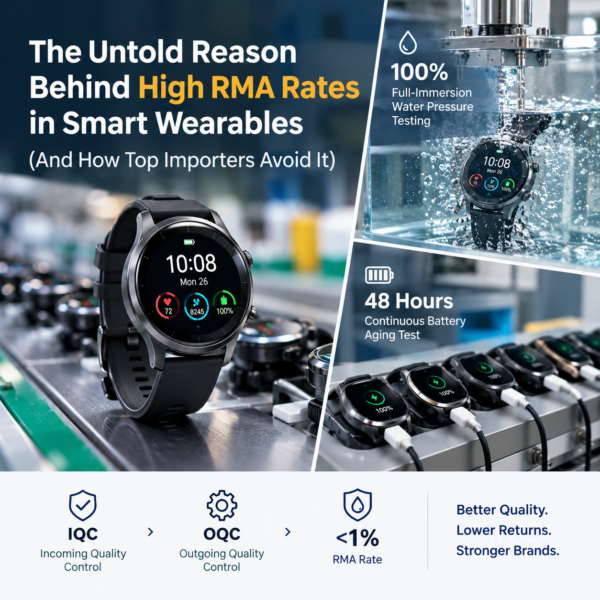
Top importers understand this, which is why they only partner with suppliers who don’t take shortcuts in quality control. In our facility, we keep our return rates strictly under 1% by focusing on two crucial stages: IQC (Incoming Quality Control) and OQC (Outgoing Quality Control).
Every component undergoes rigorous incoming inspection before assembly even begins. Before packing, every single watch goes through extended stress testing: 100% full-immersion water pressure testing (not just dry air pressure) and 48-hour continuous battery aging tests under simulated real-life loads. If a unit shows even a slight variance in voltage or seam sealing, it never leaves our floor.
Keeping RMA low isn’t magic—it’s just disciplined quality control. When you eliminate defects at the source, your brand stays protected and your customers stay loyal.
How does your team handle quality control with your current suppliers? Let’s connect and chat about keeping your return rates as close to zero as possible.
#Smartwatches #SmartWearables #SupplyChain #ManufacturingQuality #QualityControl #B2B #ElectronicsManufacturing #OEMODM #ProductQuality