

If you’re building a smart ring brand, the material decision you make before mass production is often the biggest lever for your margin — bigger than the sensor stack.
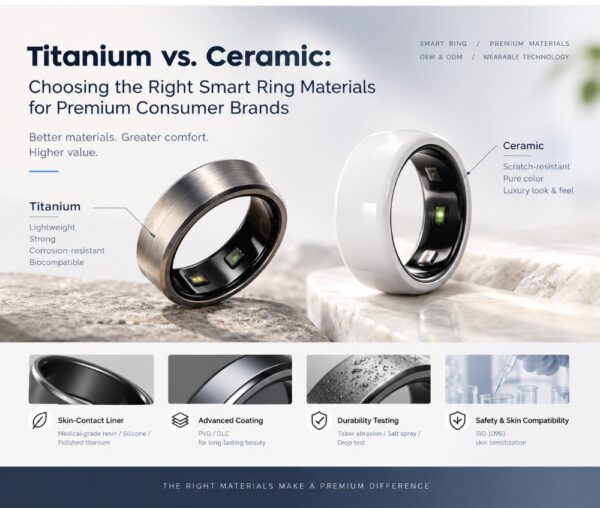
Titanium remains the reliable default: light, biocompatible, corrosion-resistant, and predictable at scale. It’s a safe choice for brands optimizing cost and yield.
Ceramic shells push into a different tier entirely. Higher hardness means near-permanent scratch resistance, true uniform color without relying on a coating, and a finish that feels closer to fine jewelry than to a gadget. The tradeoff — lower fracture toughness — has to be engineered around with wall thickness and edge design, which is exactly why it costs more to get right.
Two details separate a “good enough” ring from a premium one:
→ The skin-contact liner (medical-grade resin, silicone, or polished titanium) that determines comfort and hypoallergenic claims — often overlooked, always noticed by the wearer.
→ The coating process. PVD and DLC coatings cost more per unit than basic anodizing, but they’re the difference between a ring that still looks new after a year and one that shows brassing in months.
Backing all of it with real wear-test data — Taber abrasion, salt spray, drop testing, ISO 10993 skin sensitization — turns a materials choice into a pricing argument buyers can trust.
Material strategy isn’t just spec-sheet detail. It’s brand positioning.
#SmartRing #WearableTech #ProductDesign #ConsumerElectronics #Titanium #Ceramics #ManufacturingExcellence #IndustrialDesign